


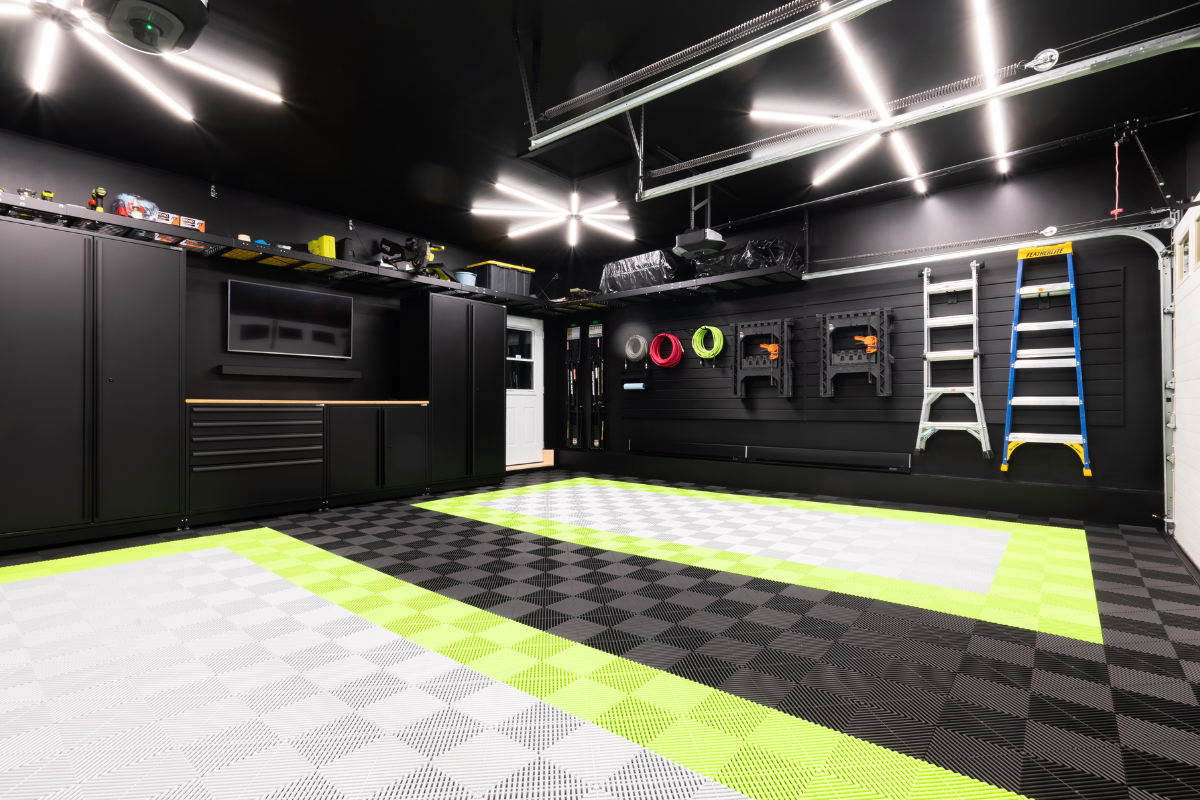
Garage cabinets are a major part of how a finished garage looks, functions and feels. But appearance is only one part of choosing the right system.
A cabinet can look impressive in photos and still fall short when it comes to construction, drawer hardware, usable storage, load capacity or long-term durability. On the other hand, specifications alone do not tell you whether a cabinet system will actually work well in your space.
So, what should you actually look for when buying garage cabinets?
Start with the materials and construction, but do not stop there. Drawer hardware, load capacity, usable storage space, cabinet dimensions, available modules, finish, installation, warranty and the company standing behind the product all matter.
The differences that matter most often become obvious only after you start using them.
So, what should you actually look for when buying garage cabinets?
Start With What You Need the Cabinets to Do
Before comparing specifications, think about what you actually plan to store.
A garage used for automotive work and power tools may need a very different configuration than one storing sports equipment, detailing supplies, totes and seasonal items.
Think about:
- What needs to go behind closed doors
- What belongs in drawers
- Whether you need space for larger totes or bins
- How much tall storage you need
- Whether you want a work surface
- Whether your storage needs may grow
- Whether you want specialty modules
- Whether you have unused vertical space above the cabinets
This is where buying a cabinet system, rather than simply a cabinet set, starts to matter.
A modular system lets you design the garage around your space and storage needs instead of forcing your garage around a predetermined package.
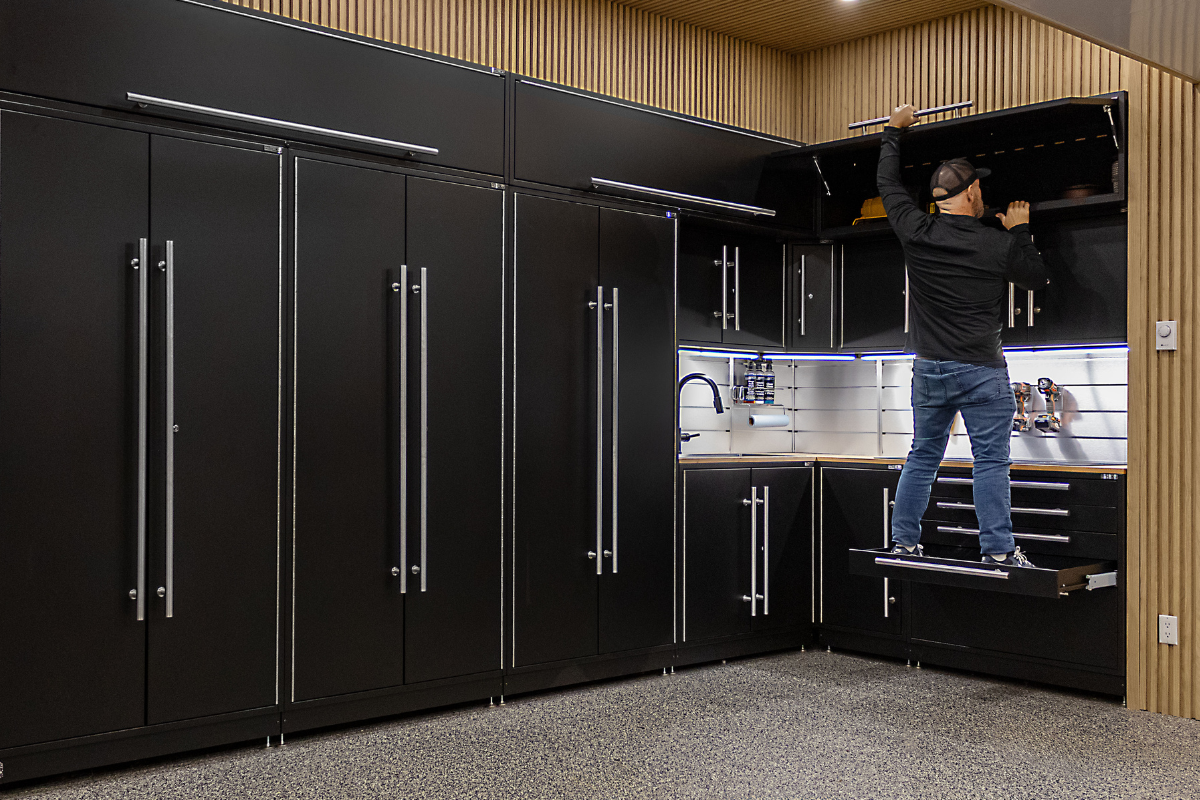
Proslat offers base cabinets, drawer cabinets, tall cabinets, wall cabinets, overhead cabinets and specialty modules that can be combined into a configuration based on how the garage will actually be used.
Choose Materials Designed for a Garage
Not every cabinet material is equally well suited to a garage environment.
Melamine cabinetry is common in kitchens, closets and other interior spaces. It is typically made using an engineered wood core with a decorative melamine surface.
A garage can be a much more demanding environment.
Humidity, changing temperatures, moisture brought in by vehicles, heavy tools and everyday impacts all affect the materials used in the space.
Steel cabinetry does not rely on a wood-based core and can be engineered for substantial loads, impact resistance and long-term use in a garage environment.
That does not mean every steel cabinet is automatically better than every melamine cabinet. Construction quality still matters.
The important question is:
Was the cabinet material selected for the environment it is going into?
For a deeper comparison, see Metal vs. Melamine Garage Cabinets: Which Is Better for a Garage?
Look at the Whole Cabinet, Not Just the Steel Gauge
Steel gauge matters, but it should not be the only specification used to judge a cabinet. With sheet steel, a lower gauge number means thicker steel, so 18-gauge steel is thicker than 20- or 24-gauge steel.
Proslat cabinets use 18-gauge galvannealed steel in the primary cabinet structure, but the material is only the starting point.
Look at how the cabinet is constructed.
- Is it fully welded or assembled from separate panels?
- How are the corners reinforced?
- Are the doors single-wall or dual-wall?
- How are the shelves supported?
- How are the drawers mounted?
- Does the structure stay rigid under load?
Proslat cabinets are fully welded and use Quad Core corner construction, creating a reinforced four-point box structure at each cabinet corner.
The goal is not simply to use substantial steel. It is to turn that material into a cabinet structure that stays rigid, square and stable under load.
Related reading: Are 18-Gauge Garage Cabinets Better? What Steel Gauge Actually Tells You
Pay Attention to the Parts That Move
You may only think about the cabinet frame once.
You will notice the drawer slides and hinges every time you use it.
When shopping in person, open the drawers and doors. When shopping online, look for actual hardware specifications.
Ask:
- How much weight can the drawer support?
- Does it remain smooth under load?
- Does it extend far enough to reach items at the back?
- Are the slides soft-close?
- What type of hinges are used?
- Can the hardware be replaced if it eventually wears?
Proslat cabinet drawers use commercial-grade Fulterer soft-close roller-bearing slides rated for up to 400 lb. per drawer.
That capacity provides substantial headroom when drawers are filled with sockets, power tools, hardware and other dense items.
Proslat also uses continuous commercial-grade hinges, with both the drawer slides and hinges backed by a lifetime warranty.
Look at How the Doors and Drawers Are Built
Hardware matters, but so does the construction of the components attached to it.
Proslat cabinet doors use dual-wall steel construction, creating a reinforced and rigid finished door rather than relying on a single sheet of steel.
The drawer fronts use a similar dual-wall approach.
A structural inner drawer panel is covered by a separate steel facade, creating a stronger, more reinforced drawer front designed to withstand repeated use.
The exterior facade can also be replaced independently if it is ever damaged or needs to be serviced, without replacing the entire drawer.
These details may be difficult to see in product photography, but they make a noticeable difference in how substantial the cabinetry feels and how it performs over time.
Compare Real Load Capacities
Terms such as “heavy-duty” do not tell you very much on their own.
Look for actual published capacities.
A large total load rating for an entire cabinet can sound impressive while telling you very little about what an individual drawer or shelf can support.
Proslat cabinet drawers are rated for up to 400 lb. per drawer, while cabinet shelves are rated for up to 200 lb.
Those component-level ratings give you a much clearer picture of what the finished cabinet has actually been designed to handle.
Look at Usable Storage, Not Just Cabinet Depth
Cabinet dimensions deserve more attention than simply asking which cabinet is deepest.
A deeper cabinet provides additional front-to-back space, but those extra inches also extend farther into the garage.
In a garage shared with one or two vehicles, that can affect:
- Vehicle-door clearance
- Walking space
- Access around the vehicle
- Work areas
- How open the garage feels
That does not mean shallower is automatically better either.
The more useful question is:
How much usable storage does the cabinet provide for the amount of garage space it occupies?
Width matters too
Depth is only one part of storage capacity.
A wider cabinet can provide substantial storage without projecting farther into the garage.
Proslat's wider tall-cabinet formats are particularly useful for larger totes, bins and bulky items, while maintaining a footprint that leaves more space around vehicles and work areas.
That can be especially valuable in garages where every inch between the cabinetry and the vehicle matters.
The deepest cabinet is not automatically the cabinet that makes the best use of the garage.
Compare cubic storage capacity
Width, height and depth all contribute to storage capacity.
A useful way to compare systems is to consider cubic storage volume, rather than evaluating one measurement independently.
Width × Height × Depth = cubic storage volume
But even cubic volume does not tell the complete story.
Shelf placement, drawer configuration, door openings and the dimensions of the items you actually need to store all affect how efficiently that volume can be used.
A cabinet can have a large cubic capacity on paper and still be poorly suited to the items going inside it.
Use the Space Above Your Cabinets
One of the most overlooked storage areas in a garage is often the space above the cabinetry.
If the garage has sufficient ceiling height, that space can provide significant additional storage without taking up any more floor area.
One of the more distinctive options within the Proslat cabinet system is our large overhead cabinets, designed to install above tall cabinets and wall-mounted cabinets.
They create another level of enclosed storage for items you want organized and protected but do not need to access every day.
Overhead cabinets are particularly useful for:
- Seasonal equipment
- Holiday items
- Long-term storage
- Extra supplies
- Items that need to stay organized but out of the primary work area
Instead of making the cabinet footprint deeper or adding another cabinet elsewhere in the garage, overhead storage makes use of vertical space that might otherwise remain empty.
For garages with sufficient ceiling height, that can significantly increase the total cubic storage capacity of the system without increasing its floor-space footprint.
That is why ceiling height should be part of the storage conversation, not just wall width and cabinet depth.
Measure the Garage, Not Just the Wall
Before choosing a cabinet configuration, measure more than the available wall length.
Consider:
- Wall width
- Ceiling height
- Cabinet depth
- Vehicle width
- Vehicle-door clearance
- Garage-door tracks and openers
- Electrical outlets
- Switches
- Windows
- Utility panels
- Baseboards and trim
- Anything else that could interfere with installation
It can also be useful to mark the proposed cabinet footprint on the floor with painter's tape.
That gives you a much better idea of how the cabinetry will affect the space once the vehicle is back inside.
A well-designed garage should provide significantly more storage without making the room unnecessarily difficult to move through.
Think Beyond the Cabinet Set You Need Today
A garage tends to evolve.
Tools change. Bikes appear. Kids' equipment changes. A small work area becomes a larger project space. You may eventually want another tall cabinet, additional drawers or a specialty module.
That is why the range of available modules matters.
Proslat cabinet systems can combine tall cabinets, base cabinets, drawer cabinets, wall cabinets, overhead storage and specialty modules.
Even if you never expand the system later, having more options means the original layout can be designed around your actual storage needs rather than whichever cabinet combination happens to come in a preconfigured package.
Look at the Finish and What Is Underneath It
Garage cabinets live in a demanding environment.
They get bumped by tools, exposed to dust, handled with dirty hands and installed in spaces that can experience significant temperature and humidity changes.
Look closely at:
- The finish
- Seams
- Handles
- Door edges
- Corners
- Hinges
- Drawer hardware
Also consider what is underneath the visible finish.
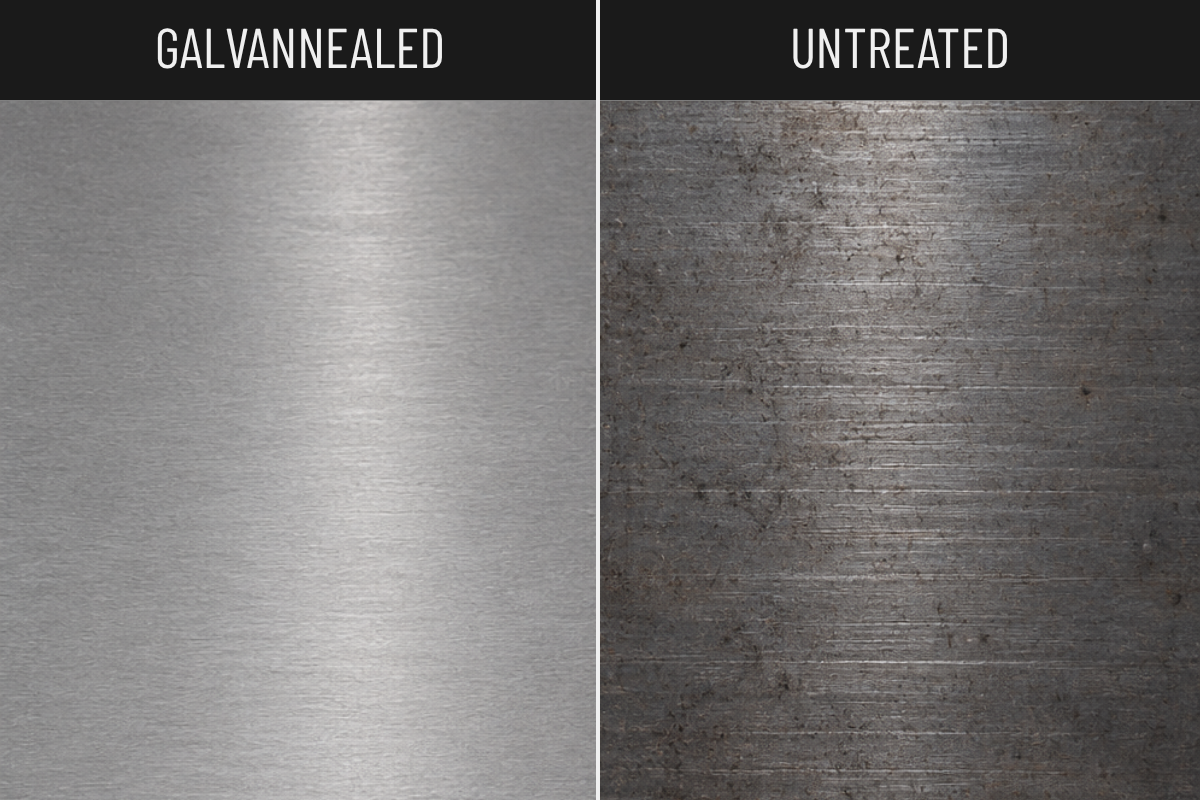
Proslat cabinets are manufactured from galvannealed steel and receive a zirconium pretreatment before powder coating, creating multiple levels of corrosion protection rather than relying only on the visible powder coat.
If you can see cabinetry in person, use the opportunity.
Open a loaded drawer.
Close the doors.
Look at the panel gaps.
Feel how the components move.
Two cabinets can look very similar online and feel completely different once you start using them.
Find Out How Much Assembly Is Required
A cabinet can be inexpensive to ship because much of the assembly has been transferred to the customer.
That is not automatically a problem, but it should be part of the comparison.
Find out whether the cabinets arrive:
- Fully assembled
- Partially assembled
- Completely flat-packed
Then consider how much installation is required, whether multiple people are needed and whether you are comfortable assembling and levelling the system yourself.
Proslat cabinet boxes are fully welded and arrive assembled, rather than requiring the customer to build the primary cabinet structure.
For larger projects, also look at whether professional design and installation support are available.
A cabinet system is ultimately part of a room. Proper planning can be just as important as the individual products.
Read the Warranty, Not Just the Word "Warranty"
Two products can both advertise a warranty while providing very different coverage.
Look at:
- What is actually covered
- How long the coverage lasts
- Whether certain components have different terms
- Whether replacement components remain available
Pay particular attention to moving components such as drawer slides and hinges because those are the parts you interact with most often.
Proslat backs its cabinet drawer slides and hinges with a lifetime warranty.
Then consider something that cannot be summarized in a specification table:
Who will answer the phone if you need help?
Garage cabinetry is a significant purchase.
Being able to reach someone for design questions, replacement components, shipping issues or support after the sale has real value.
Compare Value, Not Just the Initial Price
There is nothing wrong with comparing prices.
You should.
Just make sure you are comparing equivalent products.
Look at:
- Cabinet construction
- Base material
- Drawer and shelf capacities
- Hardware
- Usable storage capacity
- Cabinet footprint
- Available modules
- Finish and corrosion protection
- Assembly requirements
- Warranty
- Design support
- Replacement components
- After-sales support
A lower purchase price is not automatically better value, just as a higher price does not automatically mean a better cabinet.
The more useful question is:
What am I getting for what I am spending?
The goal is to understand what you are paying for and choose cabinetry you will still be happy to use years from now.
Garage Cabinet Buying Checklist
Before buying garage cabinets, compare:
- Material suited to the garage environment
- Cabinet construction, not just appearance
- Steel type and structural design
- Door and drawer-front construction
- Drawer and shelf capacities
- Drawer slide and hinge quality
- Cabinet width, depth and usable interior dimensions
- Cubic storage capacity
- Floor-space efficiency
- Tall-cabinet storage for totes and bulky items
- Ability to use vertical and overhead space
- Modular and specialty cabinet options
- Finish and corrosion protection
- Assembly and installation requirements
- Warranty coverage
- Replacement components
- Customer and design support
- Ability to expand the system later
If those details are difficult to find, ask for them.
A quality cabinet manufacturer should make it easy to understand what you are buying.
Frequently Asked Questions About Garage Cabinets
What material is best for garage cabinets?
The best material depends on the environment and how the cabinets will be used.
For a typical garage exposed to humidity, temperature changes, vehicles, heavy equipment and frequent use, steel offers advantages in load capacity, impact resistance and durability.
Material quality and construction still matter, so not every steel cabinet will perform the same way.
What gauge steel should garage cabinets be?
There is no single gauge that automatically makes a garage cabinet high quality. 18-gauge steel is a strong choice for substantial garage cabinetry, but the type of steel, cabinet construction, reinforcement, doors, drawers, shelves and hardware should all be considered alongside gauge.
Proslat cabinets use 18-gauge galvannealed steel in the primary cabinet structure.
For a deeper explanation, see Are 18-Gauge Garage Cabinets Better? What Steel Gauge Actually Tells You
Is a deeper garage cabinet better?
Not necessarily.
A deeper cabinet provides more front-to-back space, but it also projects farther into the garage.
Width, height, usable interior space, cubic capacity and vehicle clearance should all be considered alongside depth.
How should I compare garage cabinet storage capacity?
Look at width, height and depth together rather than focusing on one dimension.
Cubic volume can be useful for comparison, but interior configuration and the types of items you need to store determine how efficiently that volume can actually be used.
How can I add more garage storage without taking up more floor space?
Use vertical space.
Wall cabinets and overhead storage can add significant capacity without increasing the cabinet footprint.
Proslat overhead cabinets can be installed above tall cabinets and wall-mounted cabinets, creating additional storage for seasonal, long-term and less frequently accessed items.
Are welded garage cabinets better?
Fully welded construction can create a rigid cabinet and eliminate much of the structural assembly required with flat-packed cabinetry.
The overall design still matters, including corner reinforcement, door construction, drawer slides, hinges and shelves.
How much weight should a garage cabinet drawer hold?
There is no single capacity every homeowner needs, but it is smart to leave room to grow.
Garage storage tends to get heavier over time. You add tools, take up new hobbies, accumulate hardware, or even start using part of the garage for a side business or workshop. A drawer that feels more than adequate today may be carrying significantly more a few years from now.
Look for a published capacity on the finished drawer system, not just the drawer itself.
Proslat cabinet drawers use commercial-grade Fulterer slides and are rated for up to 400 lb. per drawer, giving you substantial capacity for the way your garage may evolve.
Are premium garage cabinets worth it?
Yes, in many cases they are. There is usually a point where spending a little more gets you significantly better construction, stronger hardware, higher load capacities and a cabinet system designed to last.
You can spend less upfront, but lower-cost cabinetry may use lighter materials, lower-capacity hardware or more basic construction. If it starts sagging, wearing out or needs to be replaced a few years later, the lower purchase price may not end up being the better value.
The goal is not to buy the most expensive cabinet available. It is to find the sweet spot between price, quality and long-term durability.
Proslat cabinets are designed to sit in that sweet spot, offering premium steel construction, commercial-grade hardware and long-term serviceability at a price that remains competitive for the level of quality.
Well-designed garage cabinetry can also make the garage feel like a finished part of the home rather than an afterthought, which can contribute to the overall appeal and perceived value of the property.
Choose Cabinets for the Garage You Want to Build
The best garage cabinets are not simply the ones with the deepest footprint, the largest capacity number or the thickest material listed on the product page.
They are the cabinets that make effective use of the space you actually have.
That means balancing material, construction quality, usable storage, width, depth, vertical space, vehicle clearance, configuration options and long-term flexibility.
At Proslat, we design our cabinet systems around those details, from fully welded 18-gauge galvannealed-steel primary construction and commercial-grade drawer hardware to wider tall storage, overhead cabinets and long-term support.
The goal is not simply to fit more cabinetry into a garage.
It is to get more useful storage out of the garage you already have.
Related Reading
Are 18-Gauge Garage Cabinets Better? What Steel Gauge Actually Tells You
Metal vs. Melamine Garage Cabinets: Which Is Better for a Garage?
Coming Soon
Galvannealed Steel vs. Regular Steel Garage Cabinets
What Makes a Garage Cabinet Resistant to Rust and Corrosion?
Are Premium Garage Cabinets Worth It?
Leave a comment
All comments are moderated before being published.
This site is protected by hCaptcha and the hCaptcha Privacy Policy and Terms of Service apply.